Tent · HobbiesPlot 18 of 19
How to Play Pickleball: Rules, Scoring and a First Game Plan
- Pinned on
- Runs for
- 5 min
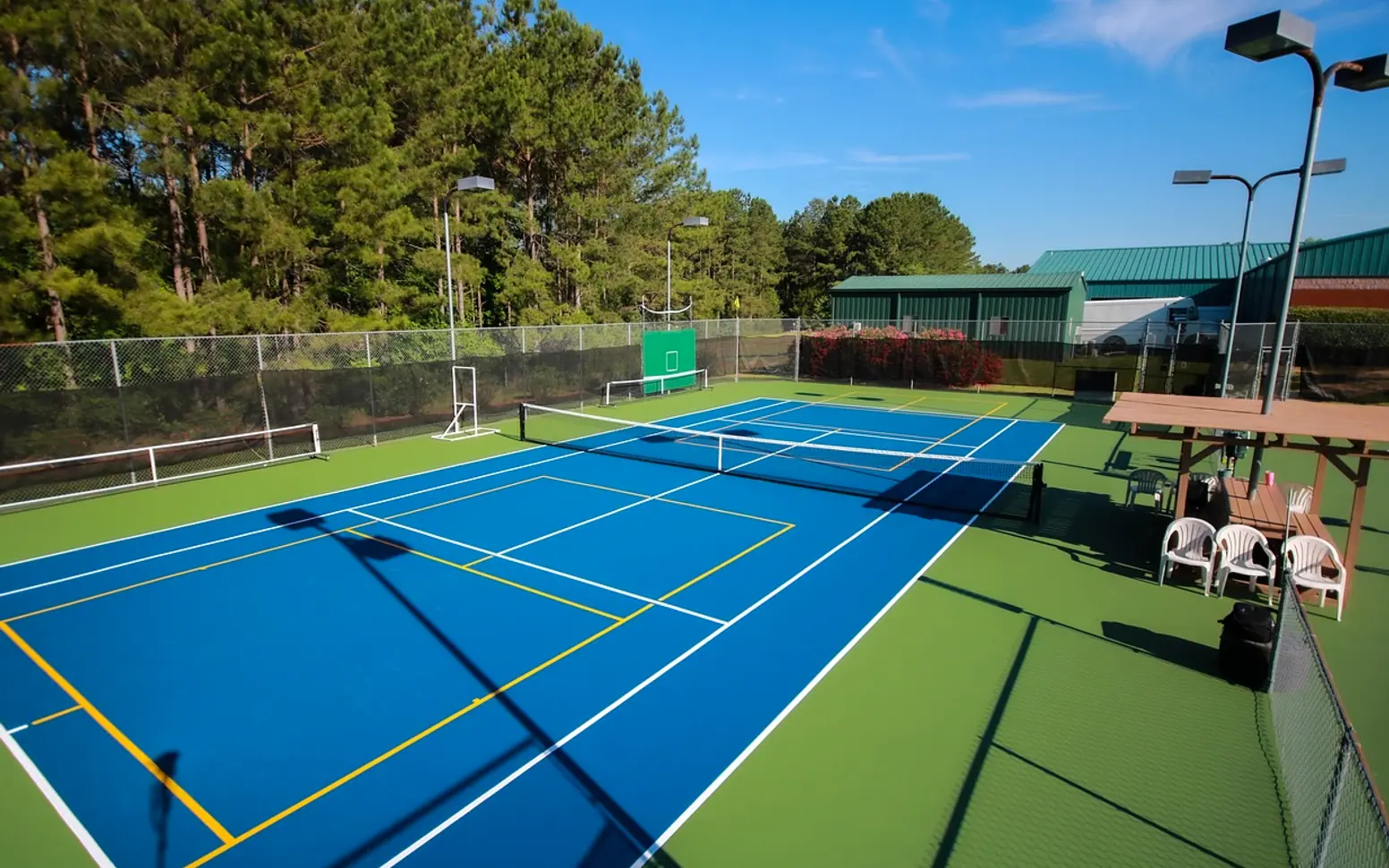
Pickleball is played with solid paddles and a light, holed plastic ball on a court about the size of a badminton court. You serve underhand and diagonally, the ball must bounce once on each side before anyone may hit it out of the air, and nobody may volley while standing in the seven-foot zone next to the net. Most games are doubles, played to 11 points, and only the serving side can score. That is enough to start; the rest of this guide fills in the detail.
It suits a free Saturday morning because it needs very little: four people, paddles, a ball and one of the courts many parks already have marked out.
The court and the kit
A standard court is 20 feet wide and 44 feet long, split by a net that sits slightly lower in the middle than at the posts. Each half has three areas worth knowing by name:
- The non-volley zone, usually called the kitchen: the strip that runs seven feet back from the net on both sides.
- The right and left service courts: the two boxes behind the kitchen, divided by a centre line.
- The baseline: the back line, which the server stands behind.
Paddles are smooth and solid, with no strings; a mid-weight paddle with a comfortable grip is plenty to start, and many venues lend them out. Outdoor balls are harder with smaller holes so the wind moves them less; indoor balls are softer with larger holes. Court shoes with good side support matter more than any paddle, because the game is full of short sideways steps.
How the serve works
Every rally starts with an underhand serve from behind the baseline, contacted below the waist. It travels diagonally, from the right service court into the opponents' right service court or from left to left, and it must clear the kitchen. A serve that lands on the kitchen line counts as short and is a fault. Many venues also allow a drop serve, where the ball is hit after it bounces.
The first serve of each service turn comes from the right-hand side. After each point the serving side wins, the server switches sides with their partner and serves again from the other court.
The two-bounce rule
The receiving side must let the serve bounce before returning it, and the serving side must then let that return bounce before hitting it. After those two bounces, either team can volley, hitting the ball before it lands. In practice, the serving pair usually waits near the baseline for the third shot while the receivers move up towards the net.
The kitchen, explained
You may stand in the kitchen at any time, and you may step in to play a ball that has bounced there. What you may not do is volley while touching the zone or its line. Momentum counts too: if a volley carries you into the kitchen after the shot, it is still a fault. It stops players parking at the net and smashing everything, which is why soft shots that drop into the kitchen, called dinks, matter so much.
Scoring without the confusion
Traditional scoring uses side-out rules, which means only the serving side wins points. Games normally run to 11, and you must win by two. In doubles the score is called as three numbers before every serve:
- the serving team's score,
- the receiving team's score,
- whether this is the first or second server for that team.
So "5-3-2" means the servers have 5, the receivers 3, and the second partner is serving. When the first server loses a rally, the partner takes over; when the second loses one, the serve passes across. To keep the opening fair, the very first service turn of a game has only one server, which is why games traditionally start with the call "0-0-2". Some clubs now trial rally scoring, where every rally earns a point, so ask which format is in use before starting.
What counts as a fault?
- The ball lands outside the court or fails to clear the net.
- The ball bounces twice before you return it.
- You volley before the two-bounce rule allows it.
- You volley from inside the kitchen or while touching its line.
- The serve lands in the wrong court or in the kitchen.
A plan for your first game
A few habits help the first session click sooner.
| Moment | What to aim for |
|---|---|
| Serving | A deep, steady serve into the middle of the box. Power can wait. |
| Returning | Hit deep, then walk forward to the kitchen line with your partner. |
| Third shot | A soft drop into the opponents' kitchen buys time to move up. |
| At the net | Paddle up, knees bent, short swings. Dink patiently and wait for a high ball. |
| Between points | Call the score out loud. It keeps everyone honest and on the right side. |
Common beginner mistakes
Swinging like it is tennis. The court is small and the ball is light, so long backswings send it out. Short, compact strokes keep it in play.
Staying at the back. The pair that reaches the kitchen line first usually controls the rally.
Forgetting the second bounce. Rushing in to volley the return of serve is the classic first-week fault.
Skipping the warm-up. Quick changes of direction ask a lot of calves, knees and shoulders. A few minutes of easy rallying and gentle mobility before playing makes sense, and anyone with a joint problem or health condition is wise to check with a doctor or physiotherapist before taking up a new sport.
Where to find a game
Public courts, school gyms and community centres often hold open-play sessions where newcomers rotate in with regulars, and players are usually happy to explain the score call. For a family try-out, a quiet early weekend slot gives everyone space to learn. It also pairs neatly with the outdoor options in our family weekend ideas for every kind of weather, since children pick up the rules quickly.
If the court feels too competitive for some of the group, a slower outdoor hobby such as metal detecting for beginners fills the rest of the day nicely, and a game in a park across town can be the anchor for one of the days in our staycation ideas.
Can you play pickleball with two people?
Yes. Singles uses the same court and rules, but the score is called with just two numbers, and the server serves from the right when their score is even and from the left when it is odd.
Got a topic idea?
A short note is enough.